
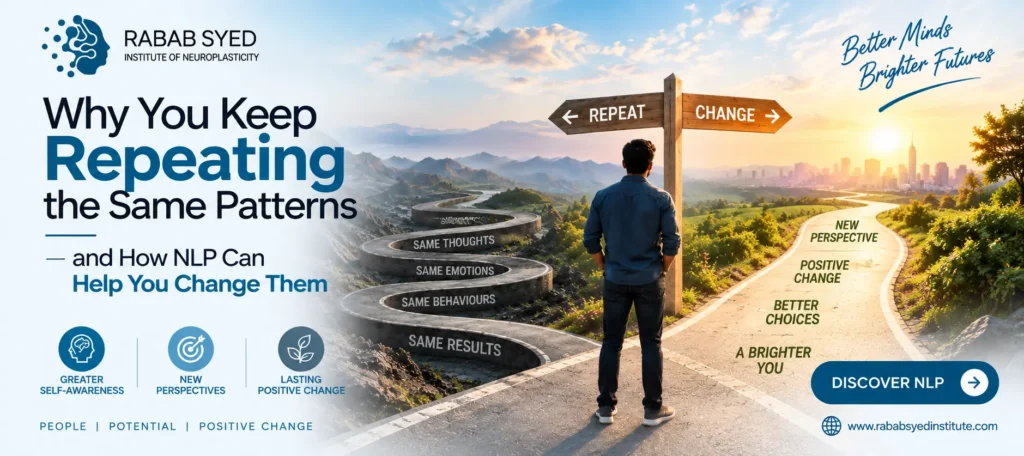
Why You Keep Repeating the Same Patterns — and How NLP Can Help You Change
Have you ever promised yourself: “Next time, I’ll handle it differently.”
And then the next time comes—and somehow you respond almost exactly the same way?
You enter another relationship and encounter familiar problems. You start another goal with enthusiasm but gradually lose momentum. You tell yourself you will speak confidently in the next meeting, yet when the moment arrives, you hold back again.
You decide not to react angrily, but a familiar comment produces the same familiar response. You know procrastination is costing you opportunities, yet you continue postponing the things that matter.
Perhaps you even understand intellectually what needs to change.
But knowing what to change and actually changing a pattern are not always the same thing.
This is one reason people become interested in Neuro Linguistic Programming (NLP).
NLP offers a framework for paying closer attention to connections between language, internal experience, learned patterns and behaviour. Rather than simply asking, “What’s wrong with me?”, an NLP-oriented approach encourages a potentially more useful question:
“What pattern am I running—and what could I do differently?”
That shift—from judging yourself to becoming curious about the pattern—can open a different conversation about personal change.
Why Do We Repeat Patterns Even When We Know They Don’t Work?
Human beings learn through repetition.
Think about driving.
When you first learned to drive, almost everything demanded conscious attention. You had to think about the steering wheel, mirrors, pedals, indicators, traffic and distance.
After enough repetition, many of those behaviours became increasingly automatic.
That ability is extremely useful. Imagine having to consciously relearn every routine action each morning.
But automatic patterns are not limited to physical skills.
We can also develop familiar ways of:
- Interpreting situations
- Talking to ourselves
- Responding to criticism
- Handling disagreement
- Approaching opportunities
- Avoiding uncomfortable situations
- Communicating with particular people
- Thinking about our abilities
- Responding when things do not go according to plan
Some learned patterns serve us well.
Others may continue long after they have stopped being useful.
And because they have become familiar, we may experience the result without immediately noticing the process producing it.
The Pattern Often Begins Before the Behaviour
Suppose someone repeatedly avoids speaking during important meetings.
From the outside, the pattern appears simple:
Meeting → Opportunity to Speak → Silence
But internally, much more may be happening.
The person might notice an opportunity to contribute and immediately think:
“What if I say something stupid?”
They may imagine colleagues judging them.
Their body becomes tense. They hesitate. Someone else begins speaking. The opportunity passes.
Then comes another internal statement:
“See? I’m just not confident enough.”
Now consider what has happened.
There was not merely a behaviour called staying silent. There was a sequence:
Situation → Interpretation → Internal Dialogue → Response → Behaviour → Result → Meaning
Repeat that sequence often enough and it can begin to feel like:
“This is simply who I am.”
But a pattern is not necessarily an identity.
And that distinction matters.
“I Am” Can Be More Restrictive Than “I Do”
Listen to the difference between these statements:
“I failed to speak confidently in that presentation.”
and:
“I am not a confident person.”
The first describes an experience.
The second turns an experience into an identity.
People frequently use language such as:
- “I’m terrible with people.”
- “I’m not leadership material.”
- “I’m lazy.”
- “I can’t speak in public.”
- “I’m bad at relationships.”
- “I’m just an overthinker.”
- “I’ve never been disciplined.”
- “I’m not good enough.”
When repeated often enough, these descriptions can influence what people notice, attempt, avoid and expect from themselves.
One area explored in professional NLP training is developing greater awareness of language and the meanings we attach to experience.
Instead of automatically accepting:
“I’m a failure.”
we can begin exploring:
- What specifically happened?
- In which situation?
- Does this happen every time?
- What can I already do successfully?
- What would I need to learn or practise to respond differently?
The goal is not positive thinking for its own sake.
It is greater precision.
Limiting Beliefs Can Keep Old Patterns Alive
Behind repeated behaviours there may also be beliefs about ourselves, other people or what is possible.
Examples might include:
- “People like me don’t become successful.”
- “If I disagree, people won’t like me.”
- “Making mistakes means I’m incompetent.”
- “I need everyone’s approval.”
- “I’m too old to change careers.”
- “Nobody listens to me.”
- “I have to be perfect before I start.”
A belief does not need to be consciously repeated every morning to influence behaviour.
If someone strongly believes that failure would prove they are inadequate, avoiding difficult opportunities may begin to feel safer than attempting them.
The result can become self-reinforcing:
Belief → Avoidance → Fewer Experiences of Success → Stronger Belief
This is why working with limiting beliefs is an important topic in personal development.
Read our detailed guide: Limiting Beliefs: The Hidden Barrier to Success and How NLP Can Help You Break Free .
The Familiar Can Feel Easier Than the Better Alternative
People do not always repeat what makes them happy.
They often repeat what has become familiar.
Imagine someone who avoids difficult conversations.
Avoidance may provide immediate relief.
They do not have to experience the discomfort of confrontation today. But the unresolved problem remains.
So the pattern becomes:
Difficult Conversation → Discomfort → Avoidance → Immediate Relief
That immediate relief can help maintain the avoidance.
The long-term result may be poor communication, unresolved conflict or missed opportunities.
The behaviour therefore makes sense when viewed within its short-term context—even though it may produce an unwanted longer-term result.
“What is this pattern doing for me in the short term, and what is it costing me in the long term?”
That question can reveal much more than simply saying: “I need more willpower.”
Your Internal Dialogue Is Part of the Pattern
Most people talk to themselves throughout the day—not necessarily aloud, but internally.
Before an interview:
“I’m going to mess this up.”
After a mistake:
“I always do this.”
Before approaching an opportunity:
“They’ll probably say no.”
When considering something ambitious:
“Someone like me could never do that.”
Internal dialogue can influence attention, expectations and behaviour.
NLP training encourages people to become more conscious of their subjective experience, including the language they use internally.
The objective is not to replace every uncomfortable thought with an unrealistic affirmation.
It is to stop treating every automatic thought as an unquestionable fact.
A thought can be noticed. A belief can be examined. An interpretation can be reconsidered. A response can be changed.
How to Break Repeating Patterns with NLP
Learning how to break repeating patterns with NLP begins with awareness. NLP is often misunderstood as a collection of isolated techniques, but for personal development it can be more useful to think about patterns and sequences.
Ask:
- What happens immediately before the unwanted response?
- What am I paying attention to?
- What meaning am I assigning to the situation?
- What am I saying internally?
- What do I expect will happen?
- What behaviour follows?
- What result does that behaviour produce?
- What reinforces the pattern afterward?
This creates a map.
Once you can see more of the map, you have more places where change might become possible.
1. Identify the Pattern Specifically
“I keep ruining everything” is too vague to work with productively.
A more precise description might be:
“When I receive critical feedback at work, I immediately become defensive and start explaining why the problem wasn’t my fault.”
Now there is something observable.
Ask:
- When does it happen?
- With whom?
- What happens immediately before it?
- What do I think at that moment?
- What do I do next?
- What happens afterward?
Specificity transforms a vague problem into something that can be examined.
2. Separate the Behaviour from Your Identity
Instead of:
“I’m a procrastinator.”
try examining:
“I procrastinate in certain situations.”
That naturally creates another question: Which situations?
Perhaps you do not procrastinate when someone else gives you a deadline. Perhaps you procrastinate mainly when the task feels unclear. Perhaps perfectionism makes starting difficult. Perhaps you work effectively once you begin.
Those distinctions matter.
The more precisely you understand the pattern, the less useful broad identity labels become.
3. Examine the Trigger
Patterns usually occur within contexts.
A person may communicate confidently with friends but become hesitant around authority figures.
Someone may manage work deadlines effectively but continually postpone personal projects.
Another person may remain calm in most conversations but become defensive when receiving criticism.
Instead of asking:
“Why am I always like this?”
ask:
“Under what circumstances does this pattern occur?”
That is a much more useful question.
4. Notice the Meaning You Are Creating
Events and interpretations are not always identical.
Imagine your manager replies to your message with:
“Come and see me.”
One employee thinks:
“I’m in trouble.”
Another thinks:
“They probably need an update.”
The same words can produce very different internal experiences because of the meaning attached to them.
This does not mean every interpretation is equally accurate.
It means that becoming aware of interpretation allows us to ask:
“What else could this mean?”
That question is closely related to the NLP concept of reframing.
5. Reframe Without Denying Reality
Reframing is sometimes misunderstood as pretending that something negative is positive.
That is not necessary.
Suppose someone is rejected for a job.
An unrealistic reframe might be:
“This is wonderful!”
A more useful perspective could be:
“I didn’t get this position. What information can I take from the experience that improves my next application?”
The event has not changed.
The meaning and the next available action have.
Reframing is useful when it expands options, not when it denies reality.
6. Define What You Want Instead
People are often extremely clear about what they do not want.
- “I don’t want to procrastinate.”
- “I don’t want to lose my temper.”
- “I don’t want to feel nervous in presentations.”
- “I don’t want to keep choosing the wrong opportunities.”
But what should happen instead?
A stronger outcome might be:
“When I receive a difficult task, I want to define the first actionable step and begin within 15 minutes.”
Or:
“When disagreement occurs, I want to pause, listen fully and respond without immediately becoming defensive.”
Now there is a behaviour to develop.
STOP X → DEFINE Y → PRACTISE Y
7. Develop More Than One Response
One of the useful ideas associated with NLP is behavioural flexibility.
If your only response to criticism is defensiveness, you have one option.
If you can:
- Pause
- Ask for clarification
- Listen
- Separate useful feedback from opinion
- Ask for an example
- Acknowledge a mistake
- Explain your perspective calmly
you now have several options.
More options do not guarantee the perfect response, but they increase flexibility.
The objective is not to become someone who never encounters difficult situations. It is to become someone with more ways of responding to them.
8. Practise the New Pattern
Insight alone is rarely enough.
You can understand perfectly why you procrastinate and still procrastinate tomorrow.
New responses need practice.
- If you want to communicate differently, practise communicating differently.
- If you want to become more confident speaking, create opportunities to speak.
- If you want to handle criticism better, rehearse a more constructive response.
- If you want to set stronger boundaries, practise the language required to express them.
Learning is strengthened through application.
That is also why structured NLP Practitioner Training should involve more than simply watching videos or memorising terminology.
Why Willpower Alone Often Isn’t Enough
People frequently approach personal change like this:
“Next time, I’ll try harder.”
Sometimes that works. Often it does not.
If the same trigger, interpretation, internal dialogue and response remain intact, simply demanding more willpower may leave the underlying sequence unchanged.
A more useful approach is:
Awareness → Understanding → Alternative → Practice → Feedback → Adjustment
This turns change into a learning process rather than a battle against yourself.
The Same Pattern Can Appear in Different Areas of Life
Sometimes apparently unrelated problems share a similar structure.
For example:
At work: “I don’t speak because people may judge me.”
In relationships: “I don’t express what I need because they may reject me.”
In business: “I don’t promote myself because people may criticise me.”
Three different situations.
Potentially one underlying theme:
Fear of Negative Evaluation → Avoidance → Short-Term Safety → Long-Term Limitation
Recognising that structure can be more useful than treating every event as completely unrelated.
Repeating Patterns in Communication and Relationships
Some of our most persistent patterns involve other people.
A familiar disagreement can look like this:
Criticism → Defensiveness → More Criticism → Withdrawal → Frustration → More Criticism
Each person may believe they are merely responding to the other.
But together they may be creating a repeating communication loop.
Developing greater awareness allows someone to ask:
“What happens if I change my part of the sequence?”
You cannot directly control another person’s behaviour.
But changing your own communication can sometimes change the interaction that follows.
For another practical example of communication-focused NLP concepts, explore our article on Parent-Child Relationships and Better Communication with NLP .
Repeating Patterns in Your Professional Life
Repeated patterns can also affect careers.
Someone may continually:
- Avoid leadership opportunities
- Stay silent in meetings
- Postpone asking for promotion
- Abandon projects before completion
- Struggle to delegate
- Avoid difficult feedback
- Underestimate their capabilities
- Seek excessive approval
- Remain in familiar roles despite wanting something different
Professional growth therefore involves more than technical competence.
It can also require greater awareness of how we think, communicate, decide and respond under pressure.
This is why NLP-related communication and personal-development skills may be relevant to managers, entrepreneurs, educators, healthcare professionals, HR professionals, coaches and people working in leadership roles.
Can NLP Really Change Repeating Patterns?
This question deserves a responsible answer.
NLP has become popular in coaching and personal-development environments, but broad claims about its ability to treat psychological or medical conditions are not supported by strong clinical evidence.
NLP should therefore not be presented as a substitute for psychotherapy, psychiatric care, psychological treatment or other evidence-based healthcare.
For personal and professional development, a more appropriate way to understand NLP is as a framework through which people may explore areas such as:
- Communication
- Self-awareness
- Language
- Goals
- Beliefs
- Perspective
- Behavioural flexibility
- Coaching conversations
The value lies in learning to observe patterns more carefully and developing additional ways of responding—not in claiming that one technique can solve every human problem.
From “Why Am I Like This?” to “What Can I Learn to Do Differently?”
This may be one of the most useful shifts when examining repeated patterns.
When someone repeatedly experiences an unwanted result, they may begin asking:
“Why am I like this?”
That question can quickly become an identity judgment.
A more constructive question is:
“What am I currently doing, and what could I learn to do differently?”
Consider the difference:
“I’m not confident.”
becomes
“In which situations would I like to communicate more confidently?”
“I’m terrible at relationships.”
becomes
“Which communication patterns keep creating problems for me?”
“I’m lazy.”
becomes
“Under what conditions do I delay action, and when do I act effectively?”
“I always fail.”
becomes
“What specifically has not worked yet, and what needs to change in my approach?”
The problem becomes less about defining yourself and more about developing choices.
How Professional NLP Training Can Help You Explore Your Patterns
Reading about NLP can introduce concepts.
Structured training provides an opportunity to learn, practise, receive feedback and apply them.
At the Rabab Syed Institute of Neuroplasticity (RSIN) , participants can progress through structured NLP learning pathways.
These include:
Depending on the level of training, participants can explore areas such as:
- Communication and rapport
- Questioning
- Outcomes and goal setting
- Limiting beliefs
- Reframing
- Behavioural flexibility
- Subjective experience
- Personal development
- Coaching-related communication skills
You can also explore educational articles and guides through the RSIN NLP Learning Resources .
NLP Training in Pakistan: Learn More Than a Set of Techniques
For people searching for NLP Training in Pakistan, NLP Certification Pakistan, NLP Practitioner Course Pakistan, NLP Training Islamabad, NLP Training Rawalpindi or professional NLP courses , the important question is not simply which certificate you receive.
It is:
“What will I actually learn to notice and do differently?”
Professional development becomes more meaningful when knowledge moves beyond terminology and begins influencing how you observe, communicate, reflect and respond.
Change the Pattern. Change the Possibilities.
You do not need to hate an old pattern in order to change it.
You need to begin noticing it.
- What triggers it?
- What are you telling yourself?
- What assumptions are you making?
- What behaviour follows?
- What result does it create?
- What are you gaining in the short term?
- What is it costing you in the long term?
- What could you do instead?
A pattern that once happened automatically can become something you recognise.
Something you recognise can become something you examine.
Something you examine can potentially become something you respond to differently.
So the next time you catch yourself saying:
“Why do I keep doing this?”
don’t stop there.
Ask another question:
“What pattern am I repeating—and what can I learn to do differently?”
That may be a much more useful place to begin.
Ready to Understand Your Patterns and Build New Choices?
Explore professional NLP Training in Pakistan at the Rabab Syed Institute of Neuroplasticity (RSIN) and discover structured learning pathways in communication, personal development and NLP.
NLP Associate Practitioner → NLP Practitioner → NLP Master Practitioner
Start with learning. Continue with practice. Turn greater awareness into greater behavioural choice.
Professional & Wellbeing Disclaimer
This article is intended for educational and personal/professional development purposes. NLP is not presented here as a medical, psychiatric, psychological or psychotherapeutic treatment.
NLP should not replace evidence-based healthcare, psychological assessment, psychotherapy, psychiatric care or advice from an appropriately qualified healthcare professional.
Anyone experiencing significant, persistent or worsening psychological distress should seek support from an appropriately qualified healthcare or mental-health professional.